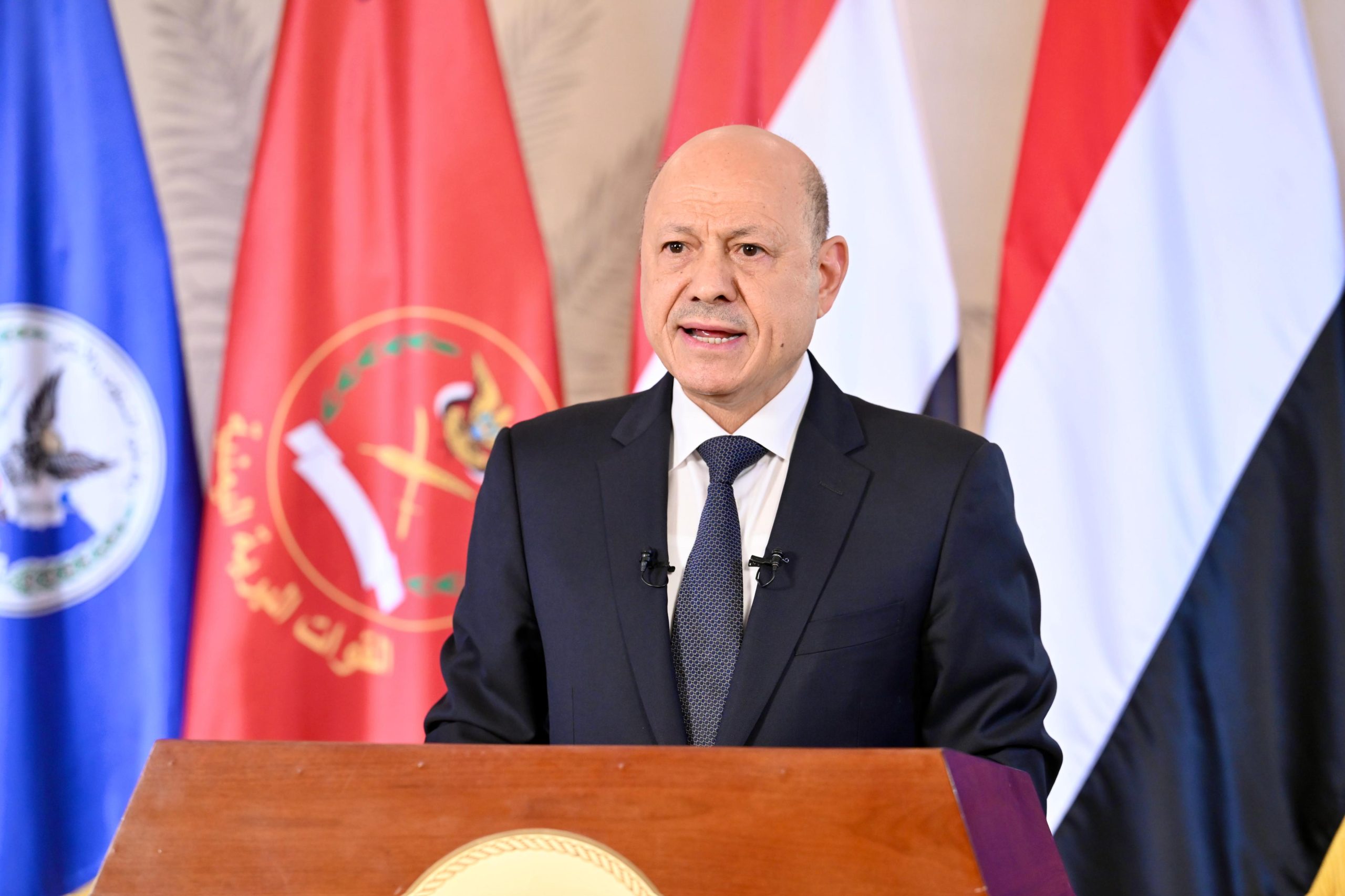
Chairman of Yemen’s Presidential Leadership Council Rashad al-Alimi said the latest escalation by the Houthi group, foremost among it the arrival of an aircraft belonging to Iran’s Islamic Revolutionary Guard Corps at Sanaa Airport, confirms that the situation in Yemen is not an internal conflict, but rather a direct extension of Iranian interventions in Yemen and the region.
Al-Alimi made the remarks during two separate meetings held on Wednesday and Thursday with the leadership bodies of the House of Representatives and the Shura Council, the Consultation and Reconciliation Commission, and leaders of the National Coalition of Political Parties and Components. The meetings discussed the Iran-backed Houthi escalation and ways to strengthen the domestic front and confront its political, military and security repercussions.
Al-Alimi said the dispatch of an aircraft belonging to the Islamic Revolutionary Guard Corps to Houthi-controlled Sanaa Airport constituted a “blatant Iranian violation of Yemeni sovereignty” and a breach of UN Security Council resolutions and the United Nations sanctions regime, according to government media.

He said preliminary information indicated that the aircraft had been used to transport personnel, experts and technologies with military and security applications, with the aim of strengthening the Houthi group’s military capabilities, while the group sought to portray the Iranian flight as humanitarian.
He explained that the aircraft’s arrival was only one manifestation of the escalation, which also includes continued mobilization and recruitment, the smuggling of weapons and military technologies, and attempted infiltrations on several fronts, particularly the western coast front, in addition to mobilization toward Marib and other areas.
He added that this escalation, alongside attacks on shipping routes, assassinations and ongoing violations, once again proved that the Houthi group “has never been a genuine partner for peace, but rather an existential threat.”
Al-Alimi stressed that any regional understandings that fail to address what he described as the root of the problem, represented by the Iranian project, would not lead to sustainable peace, arguing that the project is based on “exporting crises and investing in conflicts, rather than ending them.”
He said regional developments and Iran’s resumption of attacks against countries in the region confirmed that leniency toward Tehran and its armed proxies did not contain the threat, but instead gave them an opportunity to exploit understandings for mobilization purposes and present them as victories, regardless of the scale of destruction and suffering on the ground.
Al-Alimi said the political and diplomatic efforts led by the Yemeni government over recent days had succeeded in building a unified national narrative regarding the Iranian violation and had clearly conveyed to the international community that the conflict in Yemen represented a direct extension of Iranian interference in the affairs of Yemen and other countries in the region.
He called on legislative and consultative institutions, political parties and political components to assume a role that goes beyond traditional political activity by leading national awareness, exposing Houthi violations, unifying political and media discourse, confronting disinformation campaigns, strengthening public support for the state-building project, and supporting the armed forces and security agencies.
He said: “Our collective responsibility today is to demonstrate that the state operates with a unified team spirit and that its institutions stand in the same trench in defence of the republic, its sovereignty and the security of its citizens.”

He stressed that the battle against the Houthi group was not only military, but also a battle of awareness, law and diplomacy, adding that the most dangerous factor on which the state’s adversaries relied was not their military strength, but their targeting of national unity and their attempts to weaken citizens’ confidence in the state and its institutions.
Al-Alimi renewed the Yemeni government’s commitment to the option of peace, but stressed that it could not come at the expense of the country’s sovereignty, dignity, security and stability.
He added: “If the militias continue their escalation and reject their obligations, the state will continue to take all necessary measures to protect the interests of the Yemeni people and restore their institutions, relying on the unity of the domestic front and the determination to end the isolation endured by millions of Yemenis in areas forcibly controlled by the militias.”
Alongside efforts to confront the Houthi escalation, Al-Alimi said financial, administrative and institutional reforms constituted an integral part of the battle to restore the state, noting progress in regulating revenues, strengthening oversight and transparency, reforming the public procurement system, closing government accounts held outside the Central Bank, and improving spending efficiency.
He explained that the Houthis’ targeting of oil facilities was intended to economically paralyse the state and plunge the country into a comprehensive humanitarian crisis. However, Saudi support and the government’s continued implementation of its reform programme had contributed to thwarting this plan and strengthening an approach based on reliance on domestic resources.
He said: “A strong state is built through effective institutions, sound governance and an economy capable of withstanding pressures, alongside protecting the country and defending its sovereignty, rather than reproducing wars, crises, superstition and destruction.”
For their part, leaders of legislative and consultative institutions, political parties and political components affirmed their support for the Presidential Leadership Council and the government in the measures taken to protect national sovereignty and confront the Iran-backed Houthi escalation.
They said national unity and support for the armed forces and security agencies represented the first line of defence against the Iranian project and its instruments in Yemen.