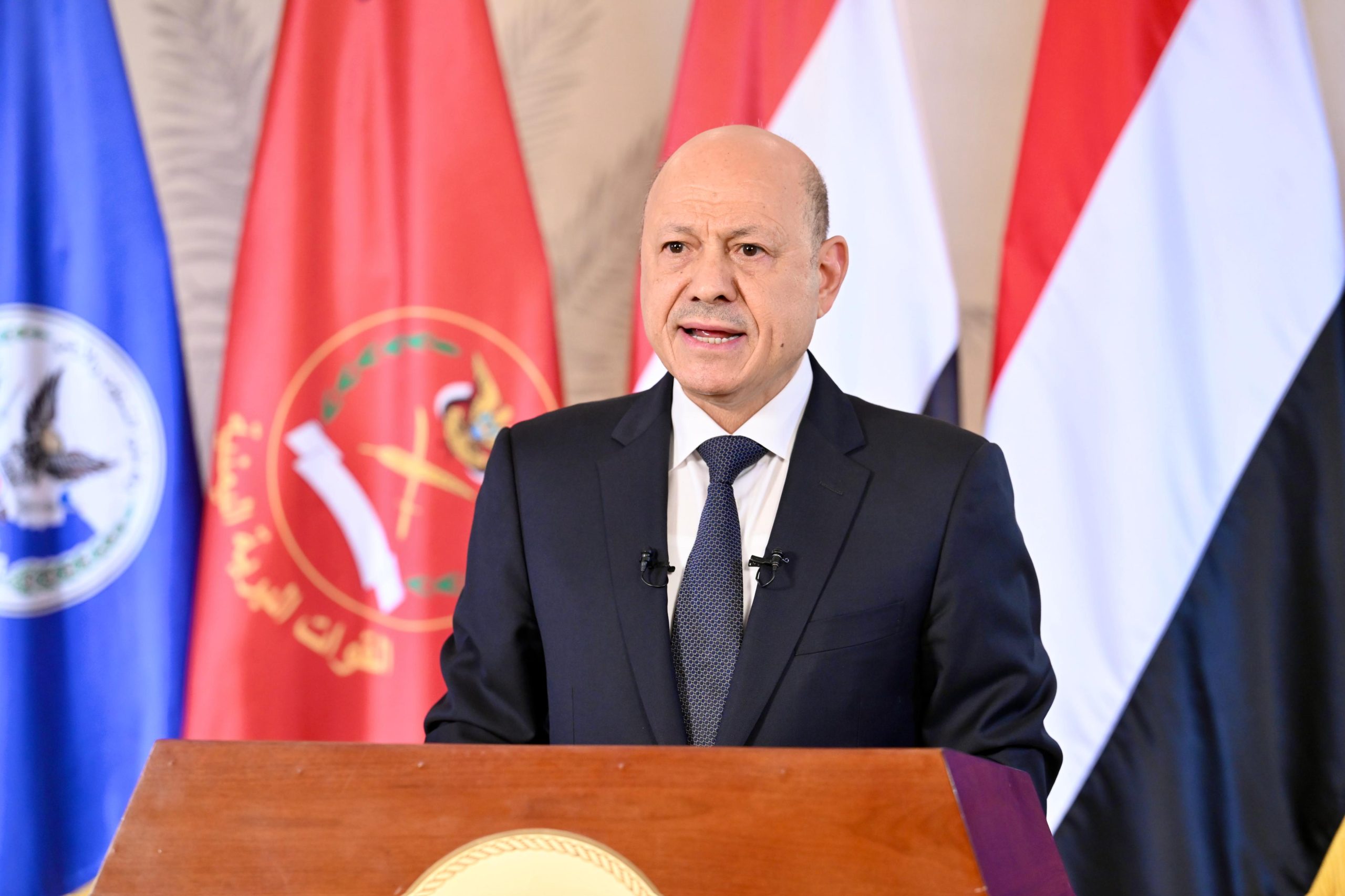
Presidential Leadership Council Chairman Rashad Al-Alimi said Saturday that the state would not allow any flights to arrive outside its exclusive jurisdiction, stressing that the Houthi group has no alternative but to accept the proposed initiatives and prioritize the interests of the Yemeni people over its narrow interests.
Al-Alimi made the remarks during a meeting held from Riyadh with Yemen’s ambassadors and heads of diplomatic missions abroad, attended by Prime Minister and Minister of Foreign Affairs and Expatriate Affairs Shaya Mohsen Al-Zindani. The meeting discussed recent developments and the measures taken by the government to address the Houthi escalation politically, diplomatically and militarily, according to official media.

Al-Alimi said the government’s welcome of any humanitarian effort, including Jordan’s recent initiative to resume flights between Amman and Sana’a, demonstrates the state’s openness to initiatives that help alleviate the suffering of citizens.
“Nevertheless, the state will not allow any flights to arrive outside its exclusive jurisdiction, and the Houthis have no alternative but to accept these options and prioritize the interests of the Yemeni people over their narrow interests,” he added.
He said the measures taken by the state in recent days were aimed at deterring any attempt to impose private agendas unrelated to the interests of the Yemeni people.
“So far, we have succeeded in shifting the perception of this development from an attempt to portray it as an operational incident involving a humanitarian flight into an issue affecting the sovereignty of a United Nations member state and a genuine test of the international community’s ability to uphold its rules and enforce its resolutions,” he said.

Al-Alimi said the government had observed growing understanding among a number of brotherly and friendly countries, urging diplomatic missions to build on this to strengthen support for the government and the Yemeni people’s aspirations for security, stability and peace.
He instructed ambassadors and heads of missions to work to deepen the Houthi group’s international isolation and reinforce respect for the sovereignty and legal standing of the Yemeni state, without harming the interests of the Yemeni people or their humanitarian priorities. He stressed that restoring state institutions represents the only path to lasting peace.
He also called for continued efforts to dismantle “misleading Houthi narratives” through arguments, facts and the provisions of international law, rather than emotional rhetoric, while highlighting the group’s human rights violations and its vision based on entrenching racism and undermining a state founded on justice, the rule of law and equal citizenship.
The Presidential Leadership Council chairman said the responsibility of diplomatic missions at the current stage extends beyond the state’s traditional representation to becoming part of the battle to defend the Republic of Yemen, its sovereignty and its legitimate institutions.
He added that national battles are no longer fought solely on the ground, but also in capitals, international organizations, the media, lobbying groups and decision-making centers.
Al-Alimi’s remarks came a day after Jordan announced an initiative to operate regular commercial flights between Amman and Sana’a. The initiative was welcomed by the Yemeni government, Saudi Arabia and the Office of the UN Special Envoy for Yemen as a step that would help meet humanitarian needs and expand access to civilian air travel for Yemenis.

The government affirmed its readiness to provide the necessary facilities to ensure the initiative’s success, provided that Sana’a Airport is operated legally and safely and in a manner that preserves the country’s sovereignty. Saudi Arabia, meanwhile, called on the Houthis to engage positively with the initiative and halt escalatory measures.
The Houthi group, however, rejected the initiative in its announced form. Officials from the group described the resumption of some flights as an “attempt to circumvent” their demand to open Sana’a Airport to all destinations.
The initiative comes amid escalating tensions over Sana’a Airport following the Iranian flights crisis, after an aircraft operated by “Mahan Air” attempted to land at the airport without the Yemeni government’s approval. The incident was followed by political and military measures that brought the aviation issue to the forefront of the Yemeni and regional landscape.