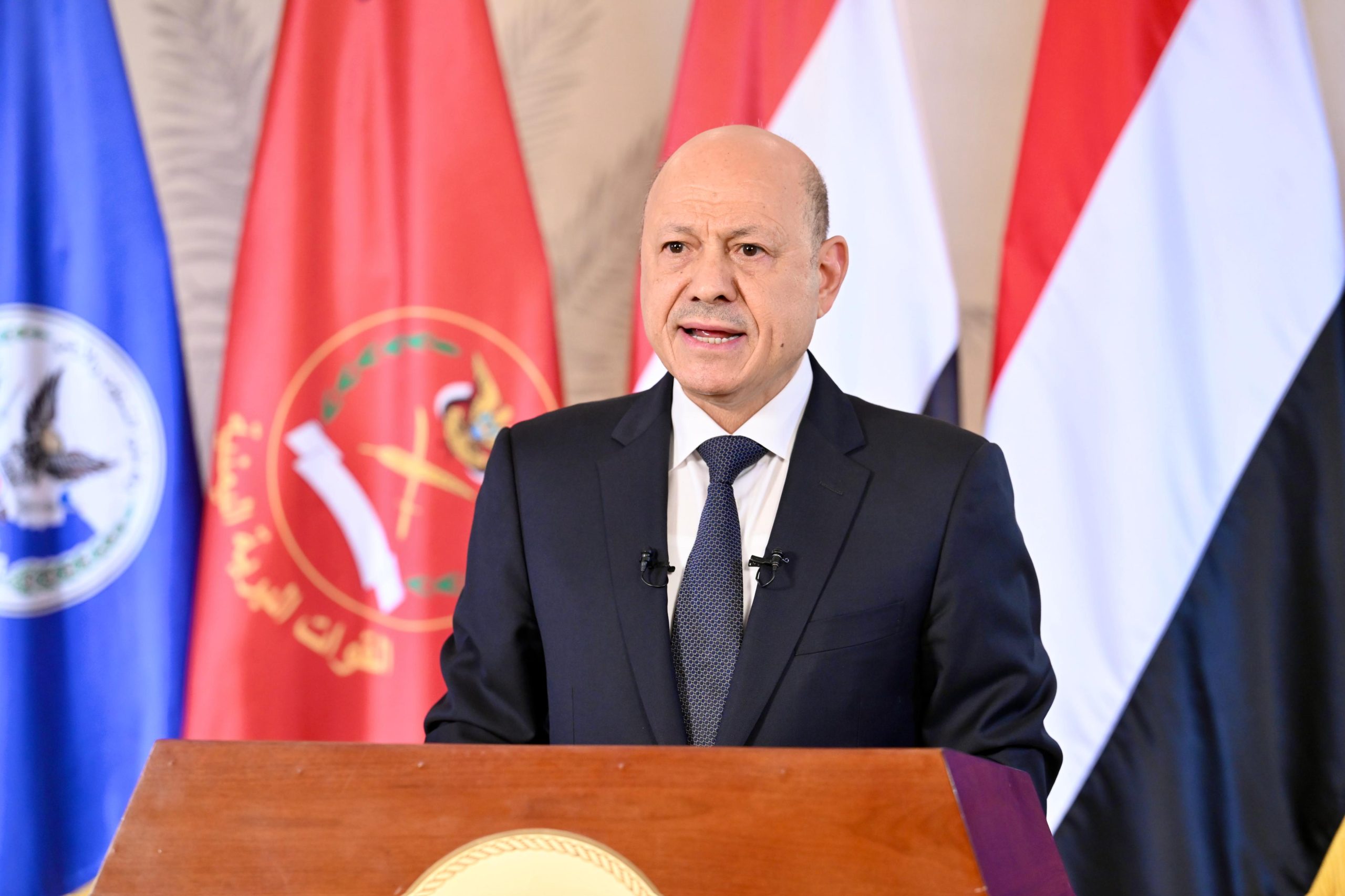
Chairman of Yemen’s Presidential Leadership Council Rashad Al-Alimi on Sunday called on the United States and the international community to move beyond a policy of “managing the Houthi threat” toward addressing its root causes and sources of strength, while bolstering the capabilities of the Yemeni government and its institutions. His remarks followed a Houthi missile and drone attack on the Port of Mokha in western Yemen.
Al-Alimi made the remarks during a meeting in Riyadh with Neil Hop, the new chargé d’affaires of the U.S. Embassy to Yemen. It was their first publicly announced meeting since the American diplomat arrived to lead the mission, according to the official Saba News Agency.
Al-Alimi said the attack on the Port of Mokha, which came days after strikes on government forces’ positions, displacement camps and civilian sites in Marib and Hadramout governorates, as well as attempts to target ships and national facilities, showed that the Houthi group was pursuing a “systematic war targeting the resources of the Yemeni people, their lifelines and economic gateways.”
He added that the group, which claims that areas under its control are under blockade, is targeting ports, airports and economic facilities while threatening commercial shipping and supplies of food and fuel, in an attempt to strangle Yemenis and deepen their humanitarian suffering.
The PLC chairman said the attack on a vital seaport near the Bab Al-Mandab Strait was an extension of what he described as “Iran’s approach of escalation,” targeting economic facilities, maritime routes and the interests of regional states. He said it also underscored the danger posed by missiles, drones and advanced weapons remaining outside state control.
Al-Alimi urged the international community, led by the United States, to shoulder its responsibility to safeguard Yemenis’ right to secure access to their ports, airports and vital facilities, and to maintain political, economic and diplomatic pressure on the Houthi group and its backers, while supporting the government’s ability to protect the country’s territory, waters and the interests of its citizens.
He said strengthening Yemeni state institutions would limit the ability of Iran and extremist groups to use Yemen as a platform for threatening the region and the world. He added that recent developments had demonstrated that state institutions and the armed forces had become more cohesive and better coordinated, and that continued attacks “will not be without political and battlefield costs.”
Al-Alimi reaffirmed the Yemeni government’s support for any diplomatic efforts capable of reducing tensions and preventing wars from erupting in the region. However, he warned that understandings that fail to sustainably address the capabilities, financing and regional threats of Iran-backed armed groups would merely postpone the crisis rather than resolve it.

He added that building sustainable security in the region requires ensuring that armed groups are not left capable of independently deciding to wage war, launching missiles and drones, and threatening maritime routes outside the authority and sovereignty of states. He argued that peace and deterrence “are not contradictory choices,” and that successful diplomacy requires an environment that prevents rogue actors from believing escalation will bring them gains.
The PLC chairman noted that the Yemeni government had made concessions over the past years to alleviate citizens’ suffering, while the Houthi group continued developing its military capabilities, threatening cities and maritime routes, undermining state institutions and strengthening its ties with Iran.
He said the group does not view peace as an end in itself, but rather as an opportunity to reposition itself. He stressed that it must not be rewarded for resorting to blackmail aft
er failing to achieve its objectives by force, and that any regional understandings should lead to nation-states that hold a monopoly over the legitimate use of force and are founded on constitutional institutions representing all their citizens.
During the meeting, Al-Alimi welcomed the new U.S. chargé d’affaires, affirming the government’s readiness to provide the necessary assistance for him to perform his duties. He also expressed appreciation for the United States’ role in supporting the Yemeni government, safeguarding regional security and freedom of international navigation, and combating terrorism.
Neil Hop arrived in the region in early August to assume his duties as chargé d’affaires of the U.S. Embassy to Yemen, nearly two months after former Ambassador Steven Fagin’s tenure ended.
The U.S. Embassy said Hop would lead its efforts to advance the priorities of President Donald Trump’s administration in Yemen and the region, foremost among them protecting freedom of navigation in the Red Sea, combating terrorism and ensuring the security of U.S. partners, in cooperation with the Yemeni government.
Hop has more than 24 years of experience at the State Department and in foreign policy and national security institutions, and has held leadership positions related to the Middle East and South Asia.
Steven Fagin assumed his post as U.S. ambassador to Yemen after presenting his credentials in Aden in June 2022. In October 2025, the U.S. State Department announced his appointment as civilian head of the Civil-Military Coordination Center tasked with supporting the implementation of President Trump’s Gaza peace plan and coordinating humanitarian aid to the enclave. Meanwhile, Deputy Chief of Mission Jonathan Peccia had served as acting head of the U.S. mission to Yemen since the second half of 2024.