Yemen has witnessed a notable political and military escalation over the past hours, after the Houthi group announced that an Iranian civilian aircraft had landed at Sana’a International Airport, which is under its control, following what it said was an attempt by Saudi warplanes to prevent its arrival. The development triggered sharp reactions from the legitimate government, the Saudi-led Arab Coalition, and the National Bloc of Political Parties and Components.
In a statement attributed to its forces and published by Houthi media on Friday, the group said that “a formation of Saudi enemy warplanes” violated Yemeni airspace at 5:20 a.m. in an attempt to prevent an Iranian civilian aircraft from landing at Sana’a International Airport. It said the plane was carrying more than 200 stranded people, wounded individuals, and patients.
The Houthi statement added that the group’s forces confronted the warplanes with several air-defense missiles and forced them to leave the airspace, a claim that has not been confirmed by independent sources.
The Houthi statement included a direct threat to Saudi Arabia, warning against any repeated attempt to “violate the airspace” or carry out what it described as “aggression targeting Yemen.” It said any such move would be met with a “comprehensive response” targeting Saudi airports and vital interests on land and at sea.
The statement also referred to the continuation of flights between Sana’a and Tehran airports, praising what it described as Iran’s initiative to “break the blockade” and transport patients, stranded people, and an official and popular delegation that took part in the funeral of Iranian Supreme Leader Ali Khamenei.
In response, Yemen’s Presidential Leadership Council described the operation of a direct flight from Iran to Sana’a Airport as “a blatant violation of the sovereignty of the Republic of Yemen” and a challenge to international law and relevant UN Security Council resolutions.
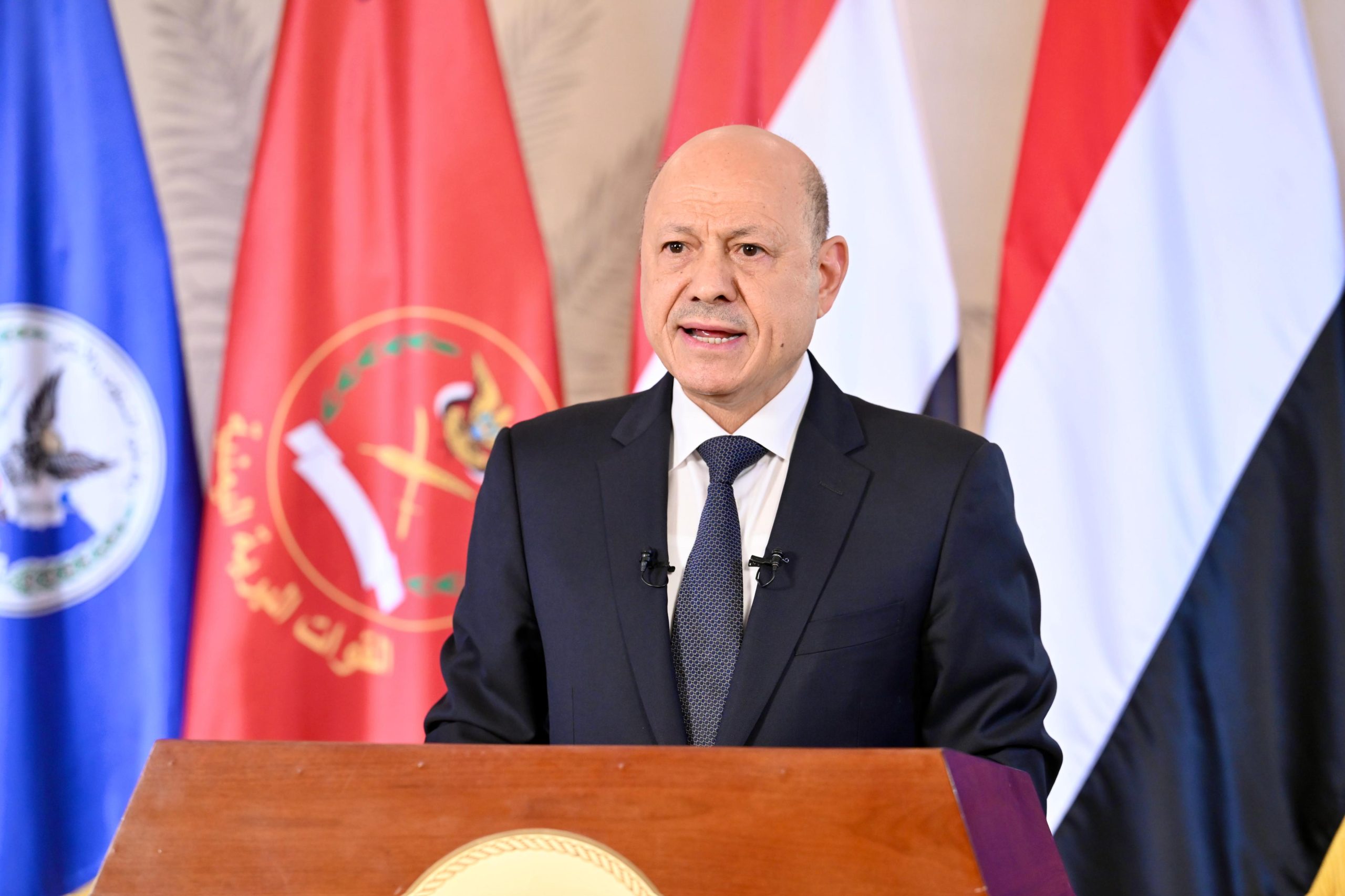
According to the Yemeni news agency “Saba,” the council held an emergency extraordinary meeting chaired by Rashad al-Alimi and attended by all its members to discuss the repercussions of the move, holding Iran and the Houthi group responsible for its consequences.
The council said the move confirms the Houthi group’s “subservience” to the Iranian project and its use of state institutions and ports to serve a foreign agenda that undermines Yemen’s sovereignty, security, and stability.
The council linked this development to the Houthis’ conduct in rejecting peace opportunities, targeting maritime navigation and international trade, and worsening the economic and humanitarian crisis.
The Presidential Leadership Council stressed that the Yemeni state will take the political, diplomatic, legal, and security measures guaranteed by international law to protect its sovereignty and exclusive rights to manage its airspace and ports. It called on the United Nations, the Security Council, and regional and international partners to move beyond condemnation toward deterrent measures that halt Iranian violations and tighten oversight of channels used to support, arm, and finance the Houthis.
For his part, the spokesperson for the Coalition forces, Major General Turki al-Malki, said the Houthi statements against the Kingdom were nothing more than an attempt to divert attention from the group’s violations against the Yemeni people, export the economic problems and suffering it has caused, and cover up the tribal and social rejection it faces.
Al-Malki, according to the Saudi Press Agency “SPA,” affirmed that the Coalition will respond “firmly and with unprecedented force” to any attempts targeting the Kingdom, its citizens, and its national assets, or violating the sovereignty of the Republic of Yemen, in accordance with international humanitarian law and its customary rules.
The National Bloc of Political Parties and Components also issued a statement describing the Houthi threats as a dangerous escalation targeting the stability of Yemen and the region, coming at a sensitive time as the liberated governorates are reorganizing their political and institutional ranks.
The bloc considered the timing of the escalation, which it said coincided with the deadline linked to a U.S.-Iranian memorandum of understanding, as further evidence that the group’s decision is not Yemeni.
The bloc condemned the Iranian aircraft’s violation of Yemeni airspace and its landing at Sana’a Airport, describing it as a violation of the sovereignty of the Republic of Yemen and a challenge to UN Security Council resolutions, foremost among them Resolution 2216.
It also called on the Yemeni government to confront any Houthi escalation firmly on various fronts, and urged the international community and the Security Council to shoulder their responsibilities regarding what it described as Iran’s flagrant breach of Yemen’s sovereignty.
This development reflects the shift of the Sana’a Airport file from a humanitarian issue linked to civilian flights, patients, and stranded travelers into a broader regional political and security confrontation, in which Yemen’s internal conflict intersects with Saudi-Iranian tensions and the course of navigation in the Red Sea and Bab al-Mandab. It also exposes the fragility of the years-long truce, as any uncoordinated air or maritime movement could push tensions back to higher levels.
These developments place the Yemeni government and the Coalition before a dual test: protecting Yemeni sovereignty and preventing ports under Houthi control from becoming open channels for Iranian support, while avoiding a wider slide that would deepen the humanitarian crisis and undermine any chance of resuming the political process.
In contrast, the Iran-backed Houthi group appears keen to exploit the event to reimpose the Sana’a Airport file within the equation of escalation, linking it to the rhetoric of “breaking the blockade” and to its alliance with Tehran.
Ultimately, the new crisis does not appear to be merely a dispute over a flight, but rather an indicator of a possible return to the logic of mutual deterrence between the Houthi group and the legitimate government backed by the Saudi-led Coalition, in parallel with the expanding Iranian presence in the Yemeni scene.