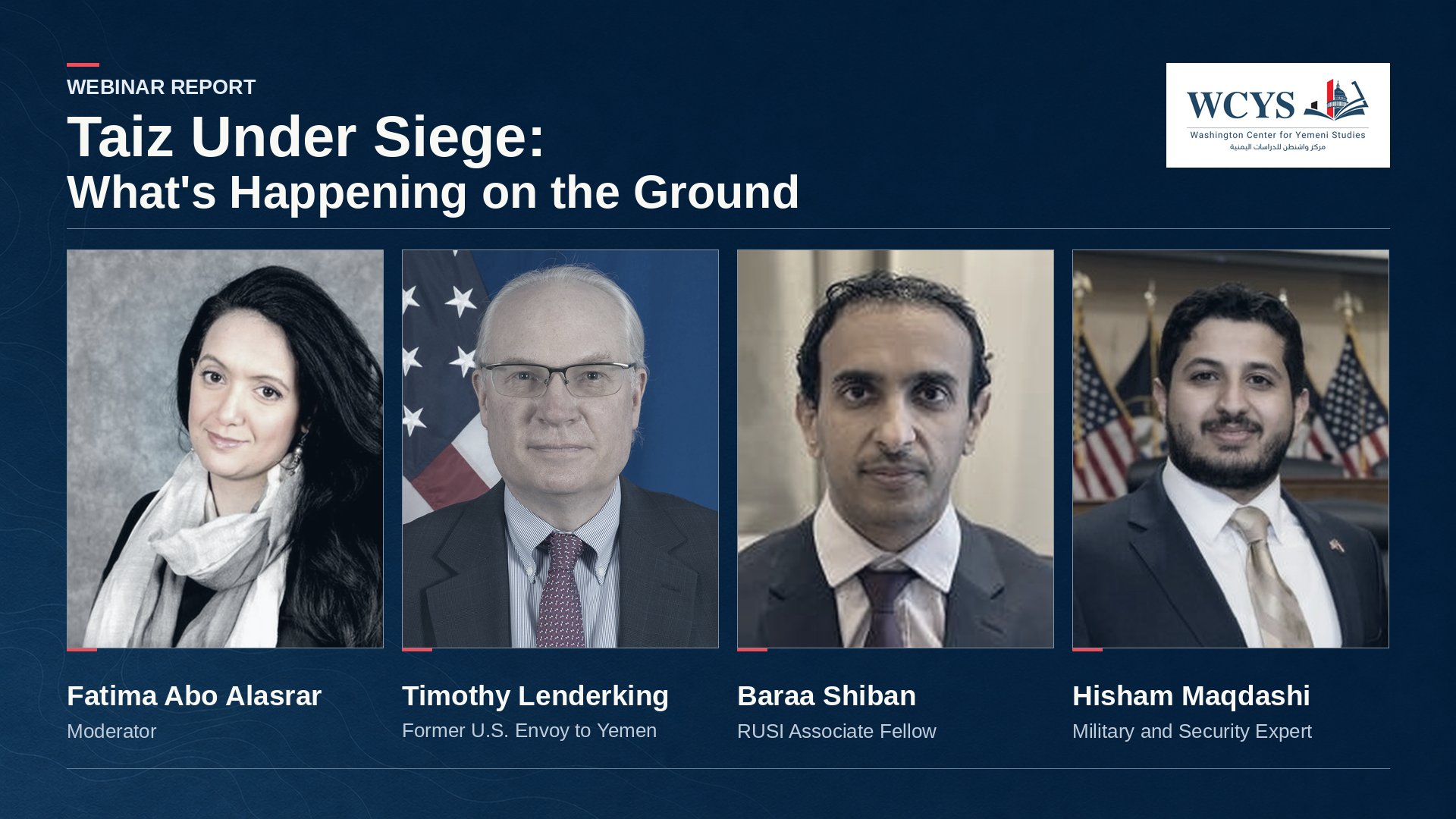
A webinar hosted by the Washington Center for Yemeni Studies (WCYS), titled “Taiz Under Siege: What’s Happening on the Ground?”, examined the consequences of the Houthis tightening their siege of Taiz, the spread of fighting into Lahj governorate, and the implications for Aden and freedom of navigation through the Bab al-Mandab Strait. Panelists shared firsthand accounts from Taiz and discussed Washington’s response to the escalation and the role U.S. diplomacy could play in supporting the Yemeni government and coordinating the efforts of its regional partners.
Fatima Abo Alasrar, a nonresident scholar at the Arab Gulf States Institute in Washington, moderated the discussion. She was joined by Ambassador Tim Lenderking, who served as U.S. Special Envoy for Yemen from 2021 to 2025, Baraa Shiban, an associate fellow at the Royal United Services Institute (RUSI) and former member of Yemen’s National Dialogue Conference, and Hisham Al-Maqdashi, a military and security expert who previously served as assistant defense attaché at the Yemeni Embassy in Washington.
Opening the discussion, Abo Alasrar said the Iran-backed Houthis had tightened their siege of Taiz since October 4, after the city had already spent about a decade under siege. She said restrictions on the movement of residents and supplies were limiting families’ access to food and medicine and forcing many to flee again. She added that fighting had spread into Lahj and that, by her estimate, Houthi forces were now about 60 kilometers from Aden.
Abo Alasrar linked the pressure on Taiz to the escalation in the Bab al-Mandab Strait. In her assessment, these developments were part of a campaign targeting the strait and threatening the Yemeni government’s position in Aden. She argued that the Houthis’ portrayal of the escalation as a confrontation with Saudi Arabia obscured the group’s efforts to expand its territorial control within Yemen.
Lenderking on how the ceasefire shapes Washington’s response
Lenderking said U.S. policymakers still had a limited understanding of the gravity of developments in Yemen. In his view, this was reflected in Washington’s response in recent months to mounting pressure on the Bab al-Mandab Strait and attacks on Saudi vessels and other maritime actors, alongside an increase in piracy in waters south of the strait.
He said the U.S. administration continued to view the conflict through the lens of the ceasefire reached with the Houthis several months earlier. The U.S. president remained committed to the understanding, which Lenderking said had largely held. He added that, in private meetings with U.S. officials, the Houthis had conveyed that they were neither targeting the United States nor seeking its involvement in the fighting. In his view, this helped explain Washington’s reluctance to enter into a direct confrontation with the group and the limited attention U.S. officials had given to the tightening siege of Taiz and the mounting pressure on Yemeni government forces.
Lenderking said Saudi Arabia had received additional U.S. support following talks with Washington, but that, in his assessment, it had fallen short of what was needed to make a tangible difference. He called for greater U.S. involvement, noting that freedom of navigation through the Bab al-Mandab Strait was important to U.S. interests and international trade. Preventing any armed group or state from asserting control over an international waterway, he said, was consistent with Washington’s stated maritime security priorities.
Asked what options were available to the administration, Lenderking said Operation Rough Rider had put substantial pressure on the Houthis before ending in May 2025. He added that Israeli pressure on the group had also eased and that, at the time of the webinar, the Houthis had gone several months without attacking Israel. In his assessment, the ceasefire with Washington had allowed the group to continue fighting within Yemen in pursuit of what he described as three objectives: “territory, influence, and legitimacy.” He also linked this pursuit to what he described as an expansion of Houthi activity into Iraq and growing ties with al-Shabaab in the Horn of Africa.
Lenderking urged Washington to use its diplomatic influence to strengthen unity within the Presidential Leadership Council and among government forces, and to help Saudi Arabia and the United Arab Emirates coordinate their policies in Yemen. He said disagreements between the two countries weakened joint efforts and identified closer alignment between Riyadh and Abu Dhabi as an area where U.S. diplomacy could help.
Shiban describes overnight spikes in food and water prices
Drawing on his recent visit to Taiz, Baraa Shiban said residents were bracing for what they described as a second phase of the siege. A rugged mountain road was the city’s only link to Aden, he said, and dozens of trucks carrying water and food used it to reach Taiz. During his visit, prices for food, water, medicines, and other essentials rose overnight. Water had become so scarce, he recalled, that people where he was staying kept count of the bottles they used.
Shiban said the hospitals he visited were struggling to obtain medicines and that some patients in public hospitals had to wait days for essential drugs to arrive. Residents began looking for alternative ways to bring supplies into the city, while civil society organizations continued to hold events and train journalists to document developments.
Shiban said his visits to several front lines revealed a stark disparity in equipment. The Houthis had heavy weapons, tanks, and armored vehicles around the city, while fighters on the government side had limited weaponry. He recalled one unit trying to cover more than one front with a single armored vehicle as pressure on the city continued.
Turning to the international response, Shiban said that acting on Saudi Arabia’s request for support in the days leading up to developments in Mokha could have changed the course of the fighting there. In his view, statements from Washington, European capitals, and London had yet to translate into support commensurate with the pace of events. He also criticized the United Kingdom and the European Union for hesitating to follow the U.S. lead in designating the Houthis, citing attacks on civilian infrastructure, airports, and Aden, as well as threats to international shipping.
Shiban proposed an international approach focused on cutting off Houthi revenue streams, preventing the group from benefiting from state assets, including in the telecommunications sector, and helping the Yemeni government consolidate its authority and unify its military command. He said that separate backing by coalition members for different armed formations had weakened coordination among them. Yemen’s partners, including the United States and the United Kingdom, could help bring those forces under a unified command within the Ministry of Defense, he said. He warned that continued escalation would increase the risks to civilians and give the Houthis more room to expand their control and influence.
Al-Maqdashi argues that lifting the siege requires unified command
Hisham Al-Maqdashi said the siege of Taiz could be lifted and that the ability of forces in the city to withstand continued attacks depended on access to essential resources and equipment. He identified fragmented decision-making and a lack of joint planning as obstacles to a broader government response. Unified command and decision-making, he said, were necessary for forces to coordinate their efforts across Yemen.
Al-Maqdashi interpreted the Houthi escalation in Taiz as a preemptive move in response to a military buildup the group believed it had detected. He pointed to the city’s importance as a center of human capital. He also linked the Houthi advance toward the Bab al-Mandab Strait to Iranian interests, arguing that the group was using escalation in the strait to pressure the international community while increasing pressure on Saudi Arabia, threatening Aden, and compounding the humanitarian crisis in Taiz.
Al-Maqdashi also addressed the change in the leadership of the Joint Forces Command. He said the need for coordinated decision-making had grown as the threat extended to Saudi Arabia, the wider region, and international shipping. He noted that for residents of Taiz, the immediate priorities were access to food and medicine and the restoration of freedom of movement. For the international community, the security of the Bab al-Mandab Strait remained a major concern.
Closing discussion on international support and a unified Yemeni plan
The closing discussion addressed the change in the leadership of the Joint Forces Command, previous U.S. understandings on Yemen, and the decision to designate the Houthis and its implications for what comes next. In his closing remarks, Lenderking acknowledged past mistakes in Washington’s handling of Yemen and said the ceasefire had temporarily halted fighting and changed the course of the conflict. He called for greater U.S. attention and support to keep the crisis from worsening.
Shiban and Al-Maqdashi closed by stressing the need for unified command and control and a comprehensive Yemeni plan with objectives ranging from lifting the siege of Taiz to retaking Sana’a.
Watch the full webinar: